
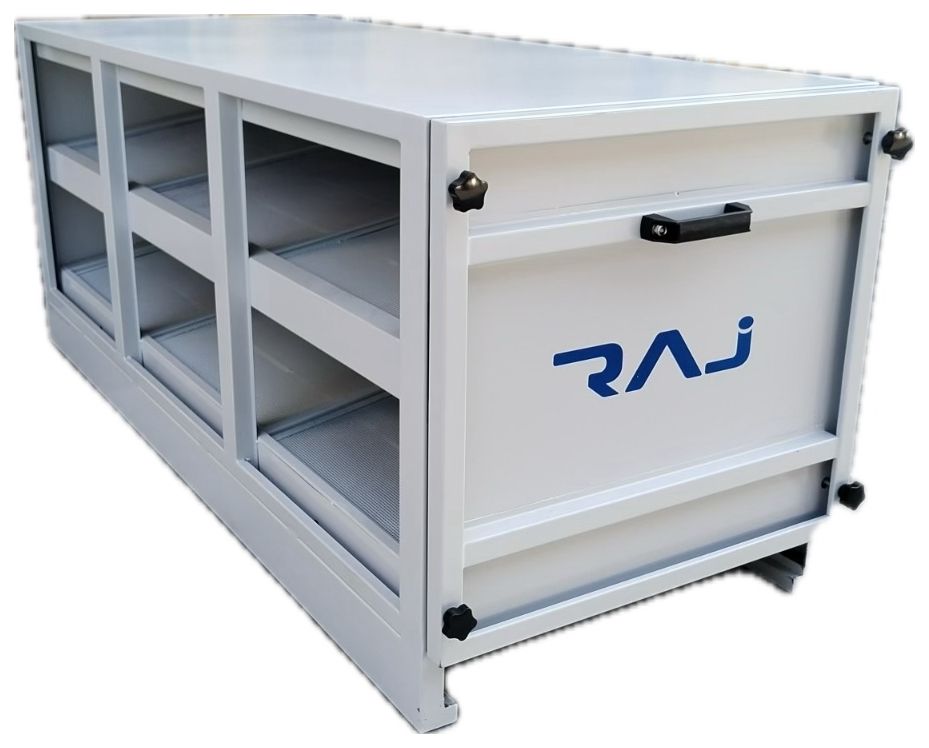
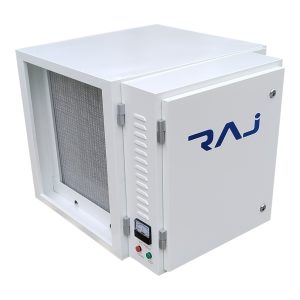
Ecology Unit Activated carbon filter SPECIFICATIONS CF-12000
12,500.00
The Ecology Unit Activated carbon filter CF-12000 offers maximum-capacity filtration for intensive commercial kitchen exhaust. By effectively removing odors and volatile organic compounds, this filter plays a critical role in maintaining high air quality and environmental safety, providing a professional-grade solution for large-scale food service facility operations.
Specifications
| Specification | Value |
|---|---|
| Model | CF-12000 |
| Airflow | CFM: 5,882 – 7,059 | CMH: 10,000 – 12,000 | L/s: 2,777 – 3,333 |
| Cabinet Dimensions | 640 mm × 1,690 mm × 590 mm |
| Flange Size | W 1,560 mm × H 530 mm |
| Cabinet Material | Carbon Steel, 1.2 mm / 18 Gauge |
| Number of Carbon Trays | 12 |
| Carbon Tray Weight (total) | 84 kg |
| Pellet Diameter | 4 mm |
| Iodine Value | 550 mg/g |
| Filling Density | 630 – 650 g/L |
| Hardness | > 93% |
| Ash Content | < 13% |
| Moisture Content | < 10% |
| Apparent Density | Approx. 0.49 g/cm³ |
| Wind Resistance | 200 Pa |
| Carbon Service Life | 3 – 5 months |
| Gross Weight | 120 kg |
Features
- Twelve carbon trays at 84 kg total media weight — the largest configuration in the CF series — sized for exhaust systems between 10,000 and 12,000 CMH serving multiple cooking lines in high-volume institutional or industrial food service operations
- The 84 kg carbon mass adsorbs 50% more organic load per service interval than the CF-8000, reducing the annual carbon replacement frequency in high-intensity cooking operations where the CF-8000’s interval would already reach its lower bound of three months
- Identical 550 mg/g iodine value and 630 – 650 g/L filling density across all CF models means each kilogram of carbon delivers the same adsorption performance regardless of which model size is installed
- 200 Pa wind resistance held constant across the CF-4000, CF-8000, and CF-12000 confirms that exhaust fan selections valid for the smaller models remain valid for the CF-12000, with no fan uprating required when scaling up carbon filtration capacity
- W 1,560 mm × H 530 mm flange dimension accepts the wide-body rectangular duct trunks used in large-scale commercial exhaust systems, connecting without a custom plenum transition
- Cabinet depth (590 mm) and height (590 mm) are identical to the CF-8000, so the CF-12000 occupies the same duct-side installation depth — only the 1,690 mm width requires additional clearance planning relative to the CF-8000’s 1,155 mm
- At 120 kg gross weight, the CF-12000 requires forklift positioning with a minimum 500 kg capacity rated machine; confirming site access for this equipment before delivery is a mandatory pre-installation step
The CF-12000 Activated Carbon Filter handles 10,000 – 12,000 CMH (5,882 – 7,059 CFM) through twelve carbon trays loaded with 84 kg of activated carbon — the largest configuration in the CF series — designed for banquet kitchens operating multiple cooking lines simultaneously, institutional cafeteria operations serving several hundred covers per service, and food processing facilities where exhaust volumes exceed the CF-8000’s 8,000 CMH ceiling. At 120 kg gross weight, it requires forklift positioning and structural verification of the mounting surface before installation begins.
The three-model CF series scales linearly: CF-4000 uses four trays at 13 – 14 kg carbon, CF-8000 doubles to eight trays at 56 kg, and CF-12000 extends to twelve trays at 84 kg — each step adding four trays and approximately 28 kg of media while keeping the cabinet depth and height constant at approximately 590 mm. Only the width grows: 620 mm for CF-4000, 1,155 mm for CF-8000, and 1,690 mm for CF-12000. This consistent depth dimension means the CF-12000 fits in the same duct-side wall clearance as its smaller siblings; only the additional 535 mm of width beyond the CF-8000 needs to be confirmed in the installation space before ordering. The W 1,560 × H 530 mm flange connects directly to wide rectangular trunk ducts standard in large commercial exhaust systems without a bespoke adapter.
For exhausts in the 7,000 – 8,000 CMH range, the CF-8000 provides equivalent carbon quality and the same 200 Pa wind resistance in a 90 kg cabinet that is 535 mm narrower and requires less clearance on-site. The CF-12000 becomes the correct specification when sustained cooking load or regulatory odour discharge limits would exhaust the CF-8000’s 56 kg carbon bed before the five-month upper bound of its service interval, making the additional 28 kg of adsorption capacity a functional requirement rather than an oversizing choice.
Reviews
There are no reviews yet.