
What is the difference between exhaust fan and fresh air fan
- No Comments
Why Air Movement Matters
Indoor air quality (IAQ) is no longer just a buzzword; it is a health necessity. Modern homes and offices are built tighter than ever to save energy. While this is great for your utility bill, it creates a problem: stale air. When air cannot escape or enter, pollutants accumulate.
This is where mechanical ventilation steps in. However, most homeowners and even some contractors confuse two critical devices: the exhaust fan and the fresh air fan (often called a supply fan or intake fan).
While both move air using similar electrical motors, their functions are polar opposites. Using the wrong fan in the wrong location can lead to mold growth, negative pressure hazards, or wasted energy.
In this article, we will break down the fundamental differences, provide a detailed comparison table, list specific use cases, and help you decide which fan solves your specific problem.
What is an Exhaust Fan? (The Air Remover)
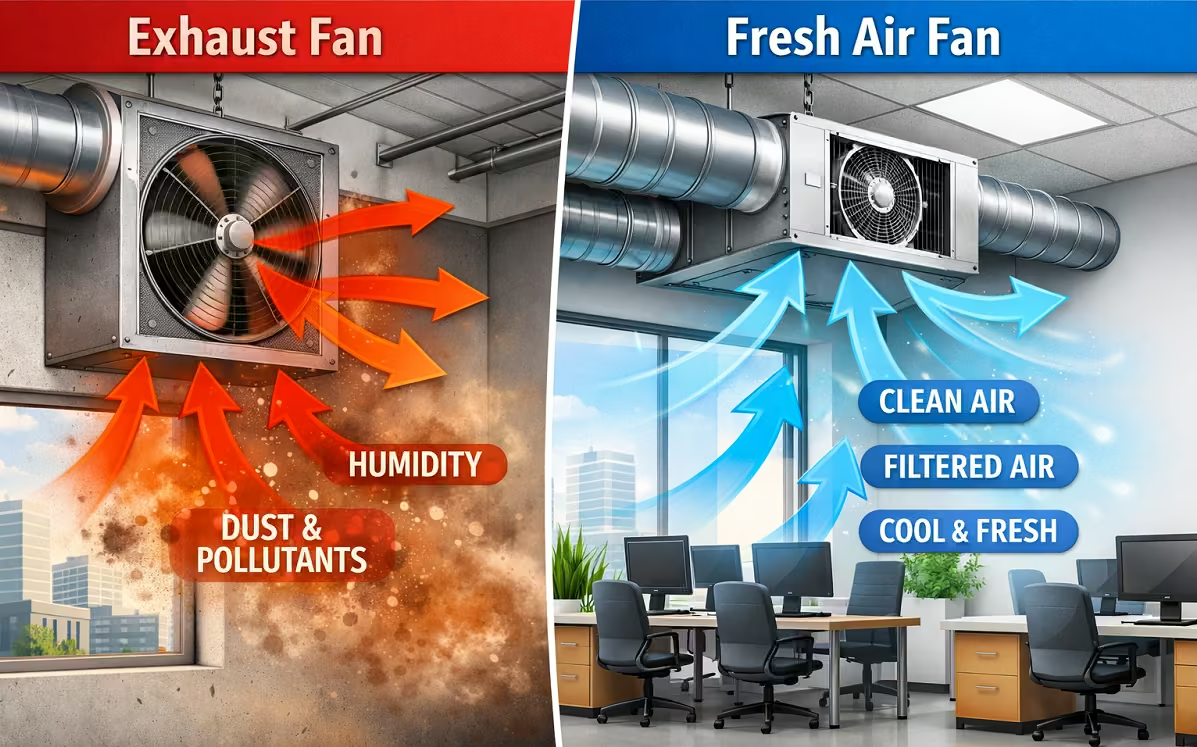
An exhaust fan is a device designed to pull air out of a specific room or building and expel it to the atmosphere. By removing air, it creates a vacuum effect (negative pressure) that draws fresh air in from any available crack, door gap, or passive vent.
How Exhaust Fans Work
The motor spins a propeller that pushes indoor air into a duct leading outside. As air leaves, the pressure inside drops. Nature hates a vacuum, so outdoor air rushes in to equalize the pressure.
Common Applications for Exhaust Fans
- Bathrooms: Removing steam, humidity, and odors.
- Kitchens: Extracting smoke, grease, and cooking fumes (range hoods).
- Industrial settings: Removing welding fumes, dust, or chemical vapors.
- Grow rooms: Controlling heat and smell.
- Restrooms: Sanitation and odor control.
Pros of Exhaust Fans
- Highly effective at removing localized contaminants.
- Relatively low cost and easy to install.
- Prevents moisture damage (mold and mildew).
Cons of Exhaust Fans
- Energy loss: They blow out expensive heated or cooled air.
- Backdraft risk: In tight homes, they can pull carbon monoxide from water heaters or fireplaces back into the living space.
- No filtration: They do not clean the air; they just move dirty air out.
What is a Fresh Air Fan? (The Air Bringer)
A fresh air fan (also known as a supply fan, intake fan, or make-up air unit) does the exact opposite. It pulls outdoor air into the building. This pressurizes the space, pushing stale indoor air out through leaks or dedicated exhaust grilles.
How Fresh Air Fans Work
The fan draws outside air through a louvered vent, passes it through a filter (often MERV 8 or higher), and blows it into the ductwork or directly into a room.
Common Applications for Fresh Air Fans
- Tight homes (Passive House/Energy Star): Bringing necessary oxygen for occupants.
- Offices: Diluting volatile organic compounds (VOCs) from furniture and copiers.
- HVAC systems: As a “fresh air intake” connected to the return plenum.
- Industrial warehouses: Replacing air expelled by large exhaust systems to prevent negative pressure.
- Positive pressure clean rooms: Keeping dust out by pushing air out.
Pros of Fresh Air Fans
- Pressurization: Keeps dust, pollen, and Radon gas from seeping in through cracks.
- Oxygen supply: Vital for sealed buildings.
- Filterable: You can clean the air before it enters your lungs.
Cons of Fresh Air Fans
- Energy penalty: Bringing in 95°F (35°C) summer air or -10°F (-23°C) winter air strains AC/furnaces.
- Humidity issues: Can bring in muggy air causing condensation problems if not conditioned.
fresh air fan vs exhaust fan
| Feature / Keyword | Exhaust Fan (Negative Pressure) | Fresh Air Fan (Positive Pressure) |
|---|---|---|
| Primary Direction | Inside → Outside (Exhausting) | Outside → Inside (Intake) |
| Pressure Impact | Negative Pressure (Vacuum) | Positive Pressure (Inflated balloon effect) |
| Main Job | Remove contaminants, heat, humidity | Supply oxygen, dilute indoor pollutants |
| Filter Requirement | Usually none (just a bug screen) | Mandatory (to prevent dust entry) |
| Effect on Neighbors | Pulls air from attics, crawlspaces, or flues | Pushes air out through building shell cracks |
| Energy Cost | High (loses conditioned air) | High (requires tempering incoming air) |
| Typical CFM | 50 – 1,500+ CFM | 50 – 5,000+ CFM |
| Noise Profile | Often louder (installed in ceiling/wall) | Can be quieter (ducted from remote location) |
| Climate Suitability | Works best in mild climates | Requires energy recovery in extreme climates |
| Code Standard | IRC (bathroom/kitchen exhaust) | ASHRAE 62.2 (fresh air for occupancy) |
Detailed Functional Breakdown
1. The Pressure Dynamics
- Exhaust Fan: Creates a negative pressure zone. If you run a 200 CFM exhaust fan in a bathroom, the house tries to pull 200 CFM from somewhere. If the house is tight, it pulls air from sewer drains or chimneys. This is dangerous.
- Fresh Air Fan: Creates a positive pressure zone. This pushes indoor air out. This is safer for combustion appliances but can force moisture into wall cavities if the outside air is very humid.
2. Filtration Capabilities
- Exhaust Fan: You generally do not filter exhaust air. You might use a grease filter (kitchen) to protect the motor, but you don’t care if the air blowing outside is dirty.
- Fresh Air Fan: Filtration is critical. Without a filter, you are just pumping pollen, road dust, and insects into your home.
3. Location and Mounting
- Exhaust fans are usually mounted high (heat rises) in ceilings or walls (bathrooms, kitchens).
- Fresh air fans are usually mounted low to mid-level (return side of HVAC) or in mechanical rooms with access to an exterior wall.
When to Use an Exhaust Fan (Use Cases)
You need an exhaust fan if your problem is too much of something bad inside the room.
Scenario 1: The Steamy Bathroom
After a 20-minute hot shower, the mirror is fogged and the paint is peeling. Solution: Install an exhaust fan (80 CFM or higher) to remove humidity before it condenses on the walls.
Scenario 2: The Smoky Kitchen
You burnt the toast. Smoke alarms are going off. Solution: A ducted exhaust range hood removes the smoke particles and odor molecules rapidly.
Scenario 3: The Cat Litter Room
No matter how much you clean, the smell persists. Solution: A continuously running low-sone exhaust fan keeps the room negative, preventing smells from drifting into the hallway.
When to Use a Fresh Air Fan (Use Cases)
You need a fresh air fan if your problem is too little of something good (oxygen) or too many VOCs building up.
Scenario 1: The Newly Built Home
Modern insulation and spray foam have sealed the house. The windows sweat in winter, and the family feels groggy. Solution: An energy recovery ventilator (ERV) or simple fresh air fan timed to run 20 minutes per hour.
Scenario 2: The Woodworking Shop
You have a massive dust collector (which is an exhaust fan) pulling 1,000 CFM. The doors are hard to open. Solution: A make-up air (fresh air) fan to equalize pressure so dust doesn’t pour in from the hallway.
Scenario 3: The Basement
Radon gas is seeping up through the slab. Solution: A slight positive pressure from a fresh air fan can keep Radon from entering, though sub-slab depressurization is more standard.
Exhaust vs. Fresh Air: Energy Considerations
This is the most expensive part of the decision. Both fans waste energy if used alone.
- Exhaust Fan Only: You pay to heat your home to 70°F. The fan blows that 70°F air to the outside. The cold 30°F air outside sneaks in through cracks to replace it. You then pay again to heat that cold air. Result: Double energy penalty.
- Fresh Air Fan Only: You pay to heat your home to 70°F. The fan brings in 30°F air. Your furnace runs longer to heat that cold air up to 70°F. Result: Single energy penalty (but still costly).
The Gold Standard: Use both fans in a balanced system (HRV/ERV). This captures the heat from the exhaust air and transfers it to the incoming fresh air, saving up to 80% of the energy loss.
5 Signs You Are Using the Wrong Fan
- You have an exhaust fan in a sealed grow tent: The tent collapses because the fan is trying to pull air out but none can get in. (You need an intake/fresh air fan).
- You have a fresh air fan in a dusty attic: You are pressurizing the attic and blowing fiberglass insulation particles down into your living room. (You need an exhaust fan).
- Your gas water heater keeps going out when the bathroom fan is on: The exhaust fan is creating negative pressure, backdrafting the water heater. (You need a fresh air make-up fan to balance).
- Your house smells like the outdoors (pollen/ragweed): Your fresh air fan is running without a proper MERV 13 filter.
- Your bathroom stays wet 2 hours after a shower: The exhaust fan is running, but it is undersized (You need higher CFM, not a fresh air fan).
Combination Strategies: ERV and HRV
For a healthy home, you need both functions but not necessarily two separate standalone fans. This is why Heat Recovery Ventilators (HRV) and Energy Recovery Ventilators (ERV) exist.
- HRV/ERV Core: Contains one exhaust fan and one fresh air fan inside one box.
- The Exhaust side pulls stale air out.
- The Fresh side pulls new air in.
- The Core transfers heat (and humidity for ERV) from one airstream to the other.
If you cannot afford an HRV, the rule of thumb is:
- Bathrooms & Kitchens: Use dedicated exhaust fans (intermittent).
- Living spaces & Bedrooms: Use a dedicated fresh air fan (continuous low speed).
Installation Checklist for Contractors
For the pro audience searching for “how to install,” here are critical steps:
- For Exhaust Fan Installation:
- Duct must slope slightly downwards toward the exterior to drain condensation.
- Use insulated flex duct to prevent sweating in attics.
- Never terminate within 10 feet of a fresh air intake (avoids cross-contamination).
- Install a backdraft damper to stop cold air from entering when off.
- For Fresh Air Fan Installation:
- Install a motorized louver on the exterior wall to open when the fan turns on.
- Wire the fan to run only when the HVAC blower is on (if tied to return duct).
- Install a balancing damper to prevent over-pressurization (max 0.05 inches of water column).
- Always put the filter before the fan to protect the motor blades.
Conclusion: Which One Do You Need?
The difference between an exhaust fan and a fresh air fan comes down to direction and intent.
- Choose an Exhaust Fan if you have a specific source of pollution (steam, smoke, odor) that you want to remove quickly. It is the hammer for the nail of contamination.
- Choose a Fresh Air Fan if your building is too tight, you feel stuffy, and you want to dilute general indoor pollutants. It is the solution for whole-home oxygenation.
- Choose BOTH (Balanced System) if you live in an extreme climate and care about your energy bill.
Final Verdict: Never run a high-power exhaust fan (like a commercial kitchen hood) without a corresponding fresh air make-up fan. Conversely, do not run a fresh air fan on a humid summer day without dehumidification. Match the tool to the task, and your indoor air will be perfect year-round.
Check your local building codes (IRC 2024 and ASHRAE 62.2). Many jurisdictions now require mechanical fresh air intake in addition to bathroom exhaust. Don’t just move air—manage it.